
This article was selected without issuer payment or pre-publication approval and prepared under Cornerstone Market Intelligence editorial standards. The source material used is linked on this page.
- Contango’s initial Lucky Shot assays included 2.45 metres grading 86.05 g/t gold as underground development exposed two previously unmodeled vein structures.
- Contango Silver & Gold reported initial assays from its 2026 Lucky Shot surface program in Alaska, including 2.45 metres grading 86.05 g/t gold in LSS26016. That interval included 0.80 metres at 244.30 g/t and 0.30 metres at 49.96 g/t from the interpreted Coleman 3 vein extension.
- A second hole returned 0.50 metres grading 81.57 g/t gold from the Coleman 1 vein. Five of the seven reported holes contained visible gold, while several other intersections returned lower-grade or narrower mineralization.
The development
Contango Silver & Gold reported initial assays from its 2026 Lucky Shot surface program in Alaska, including 2.45 metres grading 86.05 g/t gold in LSS26016. That interval included 0.80 metres at 244.30 g/t and 0.30 metres at 49.96 g/t from the interpreted Coleman 3 vein extension.
A second hole returned 0.50 metres grading 81.57 g/t gold from the Coleman 1 vein. Five of the seven reported holes contained visible gold, while several other intersections returned lower-grade or narrower mineralization.
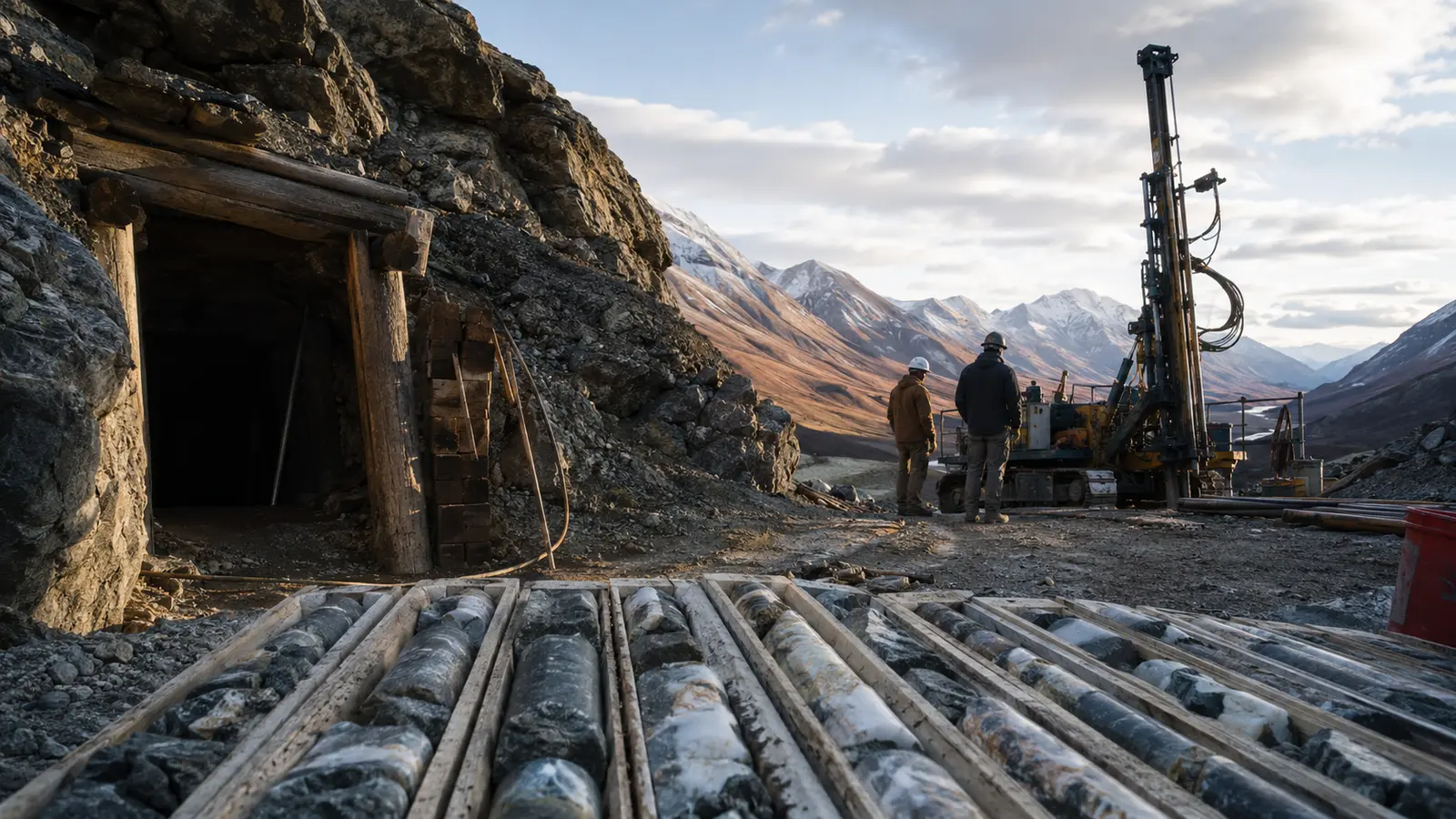
Contango has completed approximately 5,700 metres in 27 surface holes, or about 93% of its planned 6,000-metre program. The drilling is designed to improve the geometry of multiple subparallel veins and their relationship to the Lucky Shot fault system.
Underground development has advanced 332 metres of a planned 830 metres. The completed West Drift Extension encountered two previously unmodeled mineralized structures, tentatively called KM2 and KM3; a stockpile sample returned up to 395.10 g/t gold, but selective stockpile samples should not be treated as representative grades.
Lucky Shot is showing two forms of progress at once: surface holes are refining known Coleman veins, while underground access is exposing additional structures. The key is whether those observations can be converted into mineable widths, repeatable continuity and a resource model that supports the next development decision.
Why this matters
The 86.05 g/t interval provides a high-grade confirmation point for the interpreted Coleman 3 extension.
New KM-style structures encountered during development could expand the target inventory beyond the current surface-drilling model.
Industry and company context
Lucky Shot is a historic high-grade gold project in Alaska being re-evaluated with modern drilling and new underground access.
The 2026 program combines surface definition drilling with development intended to support a later underground drilling phase.
How to evaluate the update
Narrow-vein projects must be evaluated on true width, continuity, dilution and mineability rather than peak assay alone.
The new structures are most useful if channel sampling and follow-up drilling show they persist beyond the development exposure.
Execution and risk considerations
Very high grades over narrow intervals can be affected by coarse-gold variability and may be difficult to model consistently.
Underground development remains incomplete, and new structures may not sustain economic widths or continuity.
What to watch next
- Remaining assays from the surface program.
- Channel sampling and drilling of the KM2 and KM3 structures.
- Progress toward the planned 830 metres of underground development.
Cornerstone perspective
Contango’s latest result is important because it combines a strong surface intercept with new information from underground development.
The next technical step is to demonstrate that the high grades form mineable shoots rather than isolated narrow-vein spikes.
This article is informational and is not investment advice or a recommendation to buy or sell securities. Forward-looking statements involve risks and uncertainty. Readers should review the original source and report factual concerns through our corrections page.