
A detailed review of the business, leadership and publicly reported progress. Sources checked September 8, 2026.
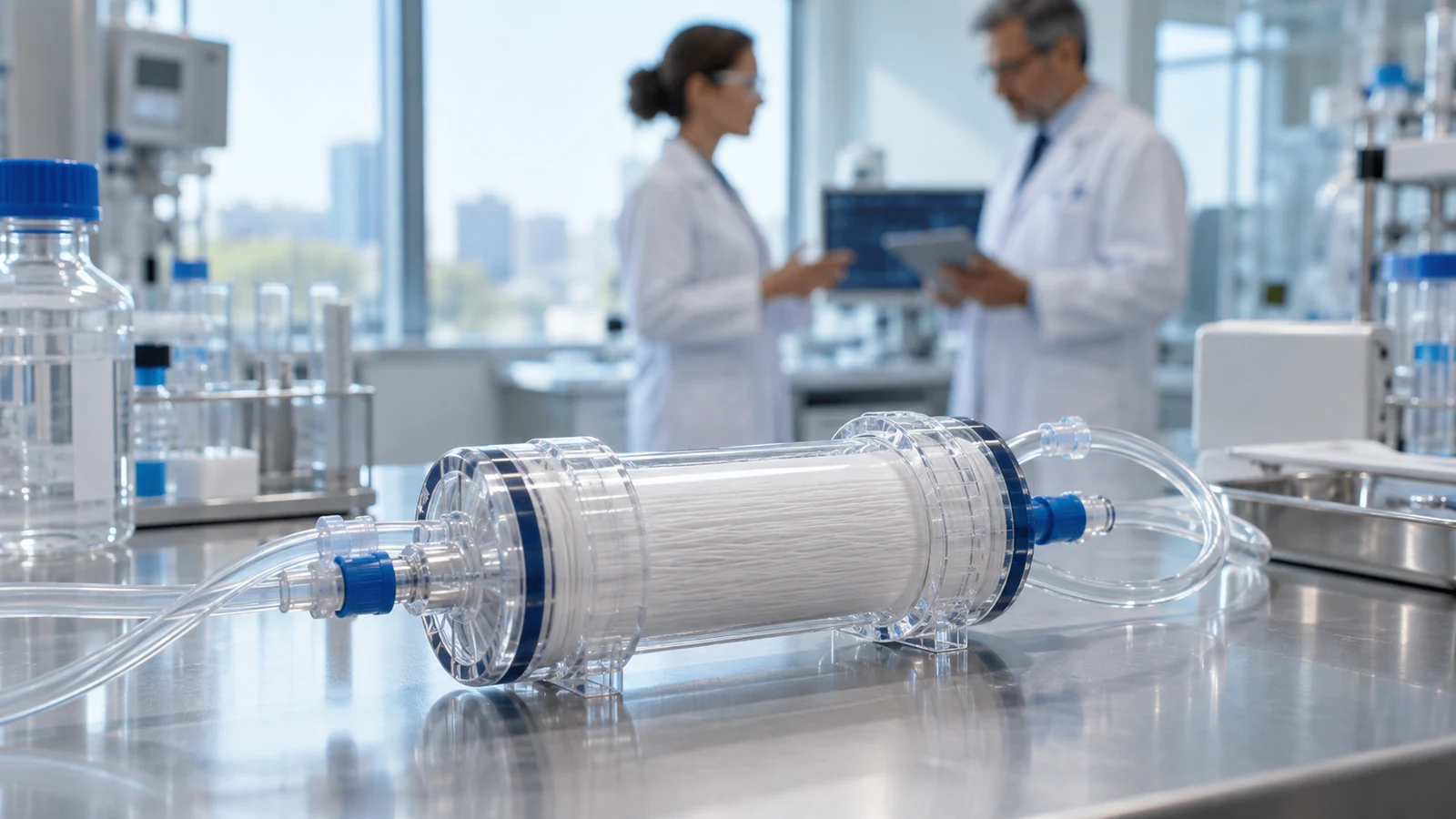
Conceptual editorial illustration; not a photograph of company assets or personnel.
- An international blood-purification platform combines disposable cartridges with established hospital equipment.
- Recent updates show encouraging observational cardiac-surgery data and improved gross margin.
- The September conference offers a checkpoint ahead of a planned early-2027 U.S. submission.
The business behind the healthcare headline
CytoSorbents is working on a practical question in critical care: how can clinicians remove selected harmful substances from blood while supporting a patient through serious illness or surgery? Its approach uses porous, biocompatible polymer beads inside a disposable cartridge. Blood passes through an external treatment circuit, allowing the material to adsorb certain substances. The company’s technology can be integrated with equipment already used in intensive care and cardiac surgery, including dialysis and extracorporeal support systems.
That compatibility is a useful part of the business design. A medical technology becomes more valuable when it can fit into an existing clinical workflow and be supported by the people already responsible for that workflow. CytoSorb has an established international commercial presence and a European CE mark. U.S. development remains a separate regulatory path: CytoSorb and DrugSorb-ATR are not broadly FDA approved or cleared. Understanding the distinction makes the commercial platform and the development opportunity easier to assess.
Sources: [5]
Why the September conference is a useful checkpoint
The September 4 announcement places chief executive Dr. Phillip Chan and chief financial officer Peter Mariani at the Moody Capital Solutions Disruptive Growth & Life Sciences Conference in New York on September 9–10. The release schedules a corporate presentation for September 10 and provides for investor meetings. It is an opportunity to hear the clinical and financial parts of the company discussed together.
For a company with both a commercial product base and a development pipeline, that combination matters. An operating update can explain where current customers are using the technology; a financial update can show how efficiently those sales support the organization. The most useful preparation is to separate those questions before the presentation. Conference attendance itself is an investor-relations event, while the company’s recently reported operating results and clinical work provide the substance to bring into that conversation.
Sources: [1]
A growing evidence base in cardiac surgery
CytoSorbents’ September 2 update described a matched real-world analysis involving 587 coronary artery bypass surgery patients exposed to ticagrelor. Severe bleeding occurred in 21.8% of the CytoSorb-treated group and 34.5% of matched controls, according to the company. The reported relative reduction was 37%. This is encouraging observational evidence, with the important distinction that a matched analysis is not a randomized trial and cannot establish that every patient will experience the same benefit.
The same release clarified the U.S. development timetable. Following FDA pre-submission discussions, the company said it planned a new ticagrelor-focused De Novo submission in early 2027 and was developing a parallel application involving certain direct oral anticoagulants. The constructive development is a more defined next step. A planned submission remains a planned submission; the useful milestone is completion of the required package and subsequent regulatory review.
Sources: [2]
Better operating efficiency creates room to execute
Second-quarter 2026 revenue was US$9.6 million, broadly unchanged from a year earlier. Within that result, the company reported a 73% gross margin, compared with 71% in the prior-year quarter and 69% in the first quarter. Its operating loss narrowed 27% to approximately US$2.6 million. These figures describe progress in the economics of the existing business even without a headline revenue increase.
That is worth following because product economics and corporate spending determine how much commercial activity contributes toward the next stage of development. The company is still working toward sustainable profitability; its stated objective of operating cash-flow breakeven in the second half of 2026 is a target. The positive point is measurable improvement in gross margin and operating efficiency. Those measures give readers a concrete baseline for evaluating subsequent quarters rather than relying solely on the size of the future market.
Sources: [3]
HotSwap shows the value of improving everyday use
In March, CytoSorbents introduced HotSwap, an exchange system designed to make replacement of CytoSorb adsorbers quicker and more straightforward. Its intended benefits include returning blood from a used device and simplifying repeated exchanges for intensive-care staff. The innovation addresses the practical steps surrounding treatment, not just the adsorptive material itself.
The company also renewed its longstanding Italian distribution relationship with Aferetica. Their work includes the PerLife organ-perfusion platform and CytoSorbents’ PerSorb cartridge. These developments illustrate two complementary ways to deepen a medical-device business: improve the experience of using the core product, and work with partners who bring local clinical relationships or adjacent applications. Our reading is that attention to implementation can be commercially significant. Hospitals need dependable processes, training and support alongside an interesting technology, so incremental workflow improvements deserve a place in the company story.
Sources: [4]
The team and the next phase of the company
Chan and Mariani represent the two disciplines that need to advance together: medical-technology development and financial execution. The company’s executive structure places clinical strategy, product commercialization and stewardship of resources within the same operating organization. That makes management’s ability to connect evidence, customer adoption and spending especially relevant to the next phase.
The opportunity ahead is to build on work already visible in the business. More efficient operations can improve the foundation beneath clinical development, while a better-defined evidence package can sharpen the discussion with prospective users and regulators. Readers can follow that progression through quarterly results, published clinical updates and the milestones management identifies at investor events. For this September research session, CytoSorbents offers a substantive healthcare story: an established international product platform, a practical approach to workflow innovation and identifiable steps toward its next regulatory submission.
Sources and further reading
This company feature focuses on publicly reported business developments and includes Cornerstone’s analysis. It is informational and is not investment advice or a recommendation to buy or sell securities. Forward-looking statements remain subject to execution and uncertainty. Review the linked sources and report factual concerns through our corrections page.