
Source-linked company news and Cornerstone analysis. Sources checked September 19, 2026.
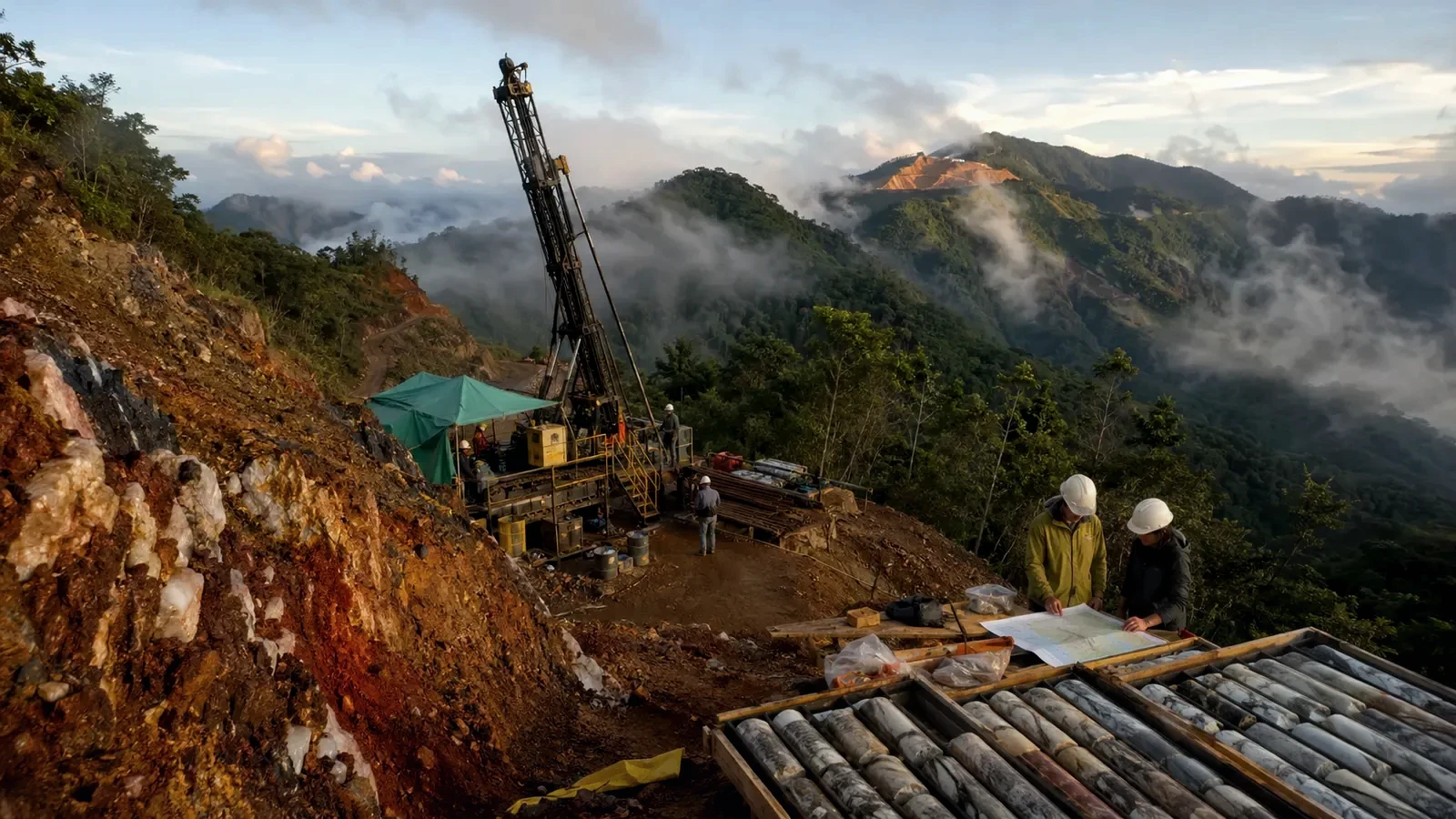
Editorial illustration prepared for Cornerstone Market Intelligence; not a photograph of the announced event.
- Nicola has begun the first diamond drill test of the MB Zone at Treasure Mountain, using four holes totaling approximately 800 metres.
- The target sits about one kilometre northwest of the historic mine and follows surface sampling that returned high silver with lead, zinc, copper and gold values.
- Drilling is expected to finish by the end of September, with assays targeted for release by year-end.
A surface target is finally getting its first test at depth
Nicola Mining has moved the MB Zone from surface sampling into its first-ever diamond drill program. The target is located roughly one kilometre northwest of the historic Treasure Mountain silver mine in British Columbia, close enough to sit inside the same broader project area but far enough away to represent a distinct exploration opportunity.
The 2026 plan calls for four holes totaling approximately 800 metres. The holes are designed to intersect northeast-southwest-trending quartz-sulphide veins that have been mapped and sampled at surface but have not previously been tested with drilling. That makes the program a straightforward geological question: do the mineralized structures seen at surface continue with useful width and grade below ground?
Source: [1]
Historic surface samples gave Nicola a reason to drill
Nicola’s earlier sampling provides the strongest context for why MB moved up the priority list. Among the 2019 and 2020 results highlighted by the company were samples grading 813 g/t silver with 19% zinc and 4.66% copper, and another exposed-vein sample grading 1,300 g/t silver with 2.59 g/t gold, 27.4% lead, 27.2% zinc and 1.16% copper.
Those are surface samples rather than drill intersections, so the current campaign is the step that can add depth, orientation and continuity to the picture. By positioning holes across the mapped vein system, Nicola can begin turning point samples into a three-dimensional understanding of the target.
Early core observations add momentum while assays move through the lab
Nicola reported that core from the first hole is already being sampled and submitted to AGAT Laboratories for multi-element analysis. The company’s visual logging identified sulphide-rich intervals containing pyrite, pyrrhotite and sphalerite, with photographs released alongside the program update.
The value of that early logging is directional rather than numerical. The important next step is the laboratory work, which will determine the metal content of those intervals and allow the company to compare the subsurface results with the high-grade surface samples that originally defined MB. Assays are expected by year-end, giving the program a relatively short path from first drilling to its first quantitative readout.
Source: [2]
Treasure Mountain is getting fresh exploration attention around an established asset
Treasure Mountain is a permitted silver mine approximately 30 kilometres northeast of Hope, British Columbia. The mine has been on care and maintenance since 2013, but Nicola has continued to hold and advance the property while also building out other parts of its British Columbia portfolio.
The MB program adds a new exploration angle around that established asset. Instead of limiting work to the historical mine footprint, Nicola is testing mineralized structures outside the old workings and asking whether another high-grade system can be defined nearby. With drilling expected to wrap by the end of September, the first MB assays should become one of the next concrete data points for Treasure Mountain.
Sources and further reading
This independent report summarizes public company disclosures and includes Cornerstone’s analysis. Cornerstone Marketing Inc. received no compensation for this article. It is informational and is not investment advice or a recommendation to buy or sell securities.