
This article was selected without issuer payment or pre-publication approval and prepared under Cornerstone Market Intelligence editorial standards. The source material used is linked on this page.
- Nine Mile Metals reported a 31.95-metre true-width VMS interval grading 2.52% copper equivalent in hole WD-26-10 at the Wedge Mine project in New Brunswick.
- Nine Mile Metals reported certified assay results from drill hole WD-26-10 at the Wedge Mine project in New Brunswick’s Bathurst Mining Camp. The hole intersected a 31.95-metre volcanogenic massive-sulphide interval grading 2.52% copper equivalent, including 27.25 metres at 2.87% copper equivalent and 14.15 metres at 3.73% copper equivalent.
- Within the higher-grade portion, the company reported 4.15 metres grading 5.16% copper equivalent. The broader 31.95-metre interval averaged 0.93% copper, 2.23% zinc, 0.57% lead, 24.89 grams per tonne silver and 0.49 grams per tonne gold. Nine Mile stated that the reported intervals are true widths.
The development
Nine Mile Metals reported certified assay results from drill hole WD-26-10 at the Wedge Mine project in New Brunswick’s Bathurst Mining Camp. The hole intersected a 31.95-metre volcanogenic massive-sulphide interval grading 2.52% copper equivalent, including 27.25 metres at 2.87% copper equivalent and 14.15 metres at 3.73% copper equivalent.
Within the higher-grade portion, the company reported 4.15 metres grading 5.16% copper equivalent. The broader 31.95-metre interval averaged 0.93% copper, 2.23% zinc, 0.57% lead, 24.89 grams per tonne silver and 0.49 grams per tonne gold. Nine Mile stated that the reported intervals are true widths.
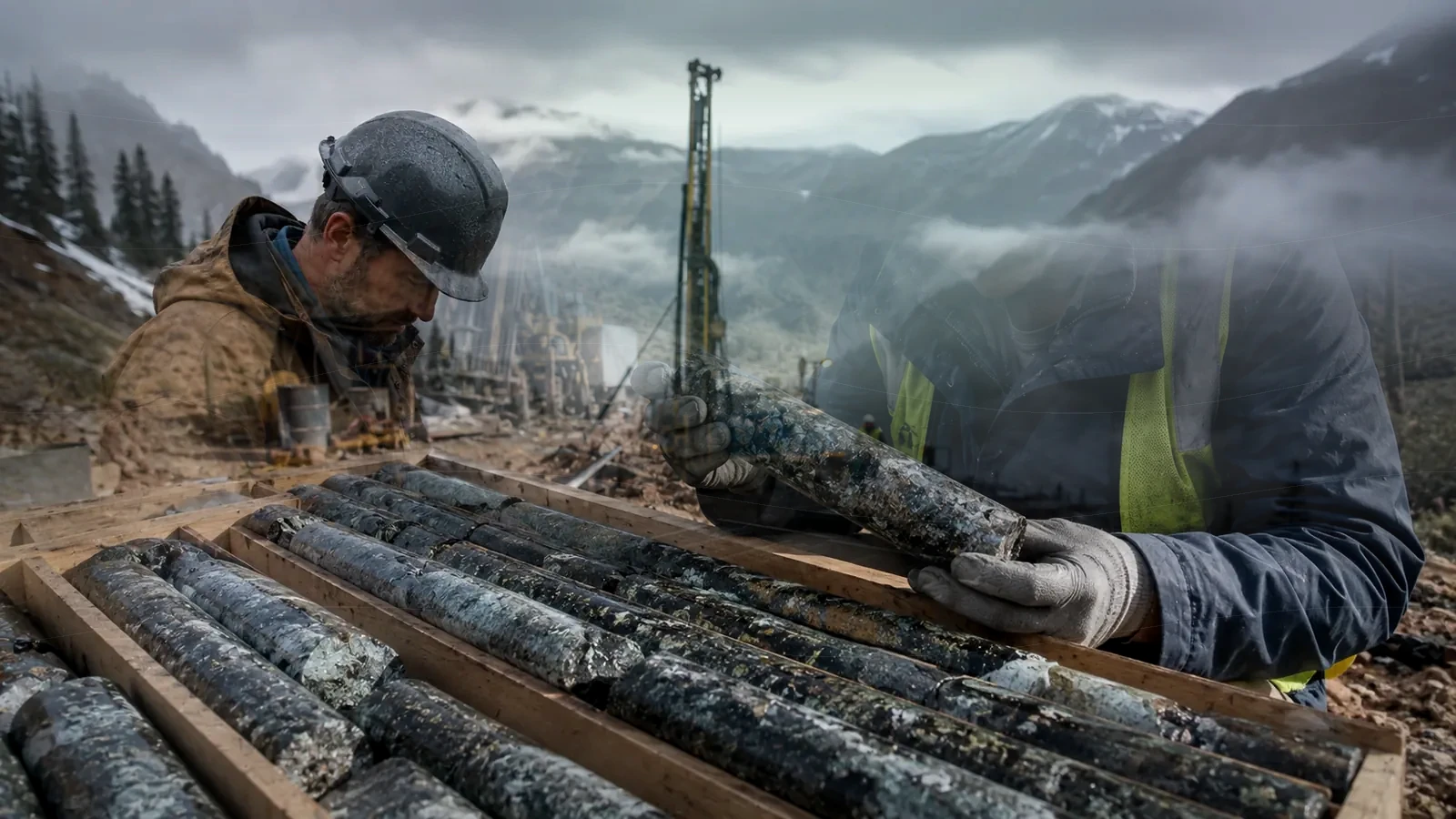
The mineralization consists of massive pyritic VMS with visible chalcopyrite, sphalerite and galena in places. Management noted a change in metal distribution with depth, including stronger silver, gold, lead and zinc values deeper in the lens. That multi-element character is relevant because the economic contribution of a VMS body can come from several payable metals rather than copper alone.
WD-26-10 was drilled on the southwestern edge of the current drill pattern. Nine Mile said the result expands the mineralized footprint in that direction and will be incorporated into 3D modelling aimed at an updated technical report and a future mineral-resource estimate.
Why this matters
The combination of width and grade makes WD-26-10 a meaningful step in defining the Wedge system. A 31.95-metre true-width interval provides more geological information than a narrow high-grade hit, particularly when the company is trying to understand continuity and geometry ahead of resource work.
The result also follows other 2026 Wedge holes that encountered high-grade VMS mineralization. Repetition across multiple holes matters because a resource estimate requires a coherent three-dimensional body rather than isolated intercepts.
Industry and company context
The Bathurst Mining Camp is a historic VMS district known for polymetallic deposits containing combinations of zinc, lead, copper, silver and gold. Nine Mile is exploring the Wedge project alongside several other VMS targets in the camp.
Copper-equivalent figures combine the theoretical value of several metals using assumed prices and recoveries. Investors should therefore examine the underlying individual grades and the company’s stated equivalency assumptions rather than relying only on the combined percentage.
How to evaluate the update
The next technical questions are continuity along strike and down dip, the shape of the sulphide lenses and how the latest assays change the emerging 3D model. Additional holes to the west and southwest should help test whether the current footprint continues to expand.
Metallurgical work will also become increasingly important as the project advances. Multi-metal VMS deposits can require complex concentrate and recovery assumptions, so eventual resource and economic studies will need more than grade and thickness alone.
Execution and risk considerations
The project does not yet have a current mineral resource based on the 2026 work. Drill intersections can change substantially in significance once geological continuity, density and mineable geometry are modeled.
Copper-equivalent values are sensitive to metal prices and recovery assumptions. Future technical reports may use different assumptions, and not all contained metals necessarily contribute equally to eventual project economics.
What to watch next
- Additional certified assays from the 2026 Wedge drill program.
- Updated 3D modelling and the timing of a revised NI 43-101 technical report.
- Progress toward a maiden or updated mineral-resource estimate and supporting metallurgical work.
Cornerstone perspective
WD-26-10 adds a substantial, polymetallic interval to Nine Mile’s 2026 Wedge dataset and strengthens the case for continued step-out drilling on the southwest side of the system.
The next value-creating stage is resource definition. Consistent geometry, repeatable grades and metallurgical evidence will determine how much of the current drill success translates into a technically coherent deposit.
This article is informational and is not investment advice or a recommendation to buy or sell securities. Forward-looking statements involve risks and uncertainty. Readers should review the original source and report factual concerns through our corrections page.