
Source-linked company news and Cornerstone analysis. Sources checked September 16, 2026.
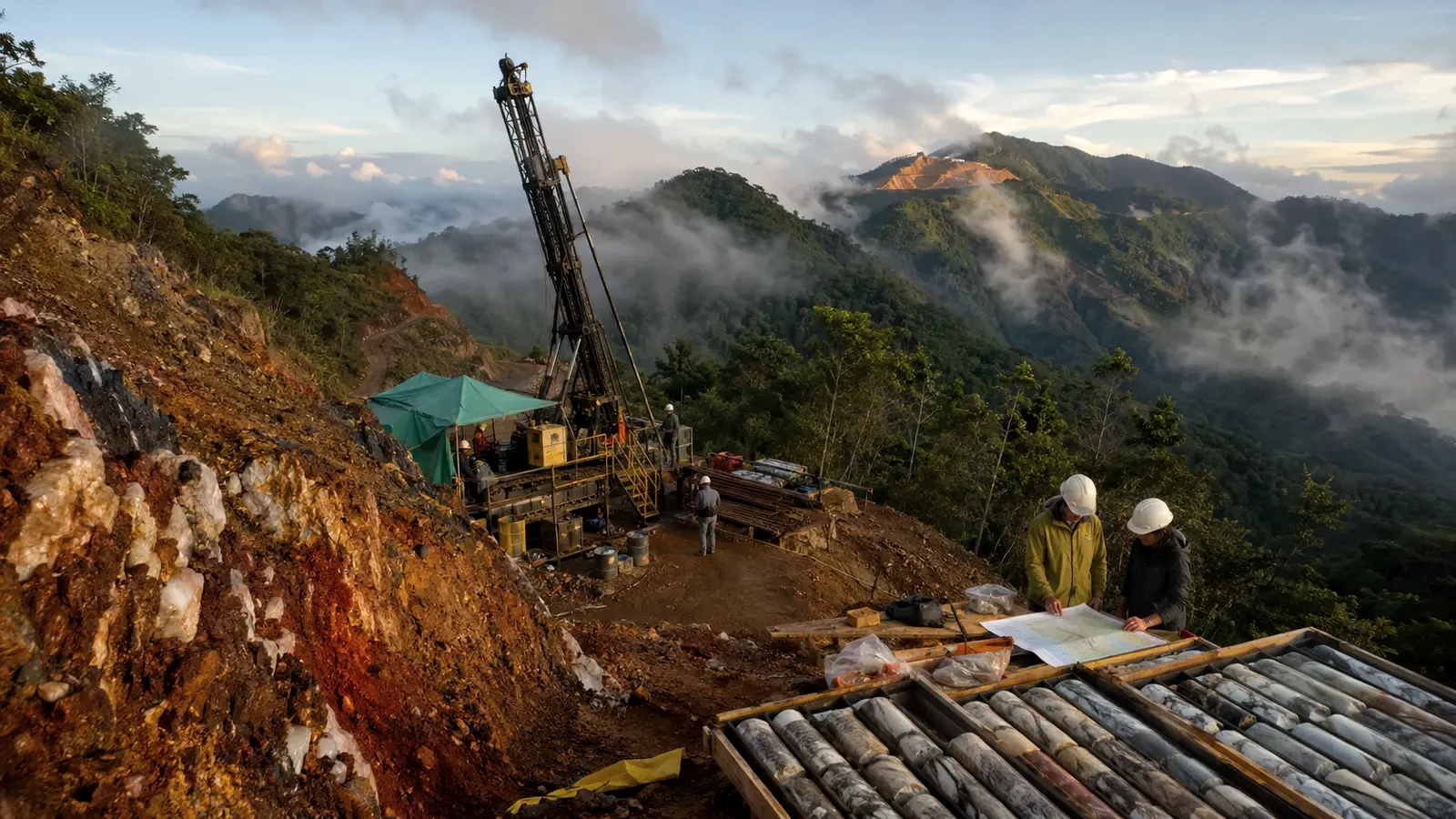
Editorial illustration prepared for Cornerstone Market Intelligence; not a photograph of the announced event.
- Approximately 1,500 metres of diamond drilling is planned across 10 holes.
- Targets include historic high-grade silver structures and an intrusion-related gold-silver prospect.
- The program follows LiDAR, geophysics, mapping and geochemical work completed during 2026.
A project milestone measured in metres, not adjectives
T2 Metals has moved the Shanghai Silver-Gold Project from target generation into direct subsurface testing. On September 16, the company said surface diamond drilling had started at the central Yukon property, marking the first surface drill program completed at Shanghai.
The current plan calls for approximately 1,500 metres in 10 holes. That is a compact program, but it is aimed at three different target areas rather than a single isolated anomaly: the historic Shanghai Silver Mine, the Shanghai NE extension and the Bella prospect. The result is a program designed to test both continuity around known mineralization and a second, broader style of gold-silver target.
Source: [1]
Two target styles give the program more than one way to add information
At the Shanghai Silver Mine and Shanghai NE prospects, T2 is targeting high-grade silver-lead-zinc vein systems comparable in style to mineralization seen in the nearby Keno Hill district. Historical work at Shanghai included underground development and reported high-grade sampling, giving the new surface holes a defined geological starting point rather than a blank-sheet exploration concept.
Bella is different. It is being tested as an intrusion-related gold-silver target associated with the regional Robert Service Thrust. T2 says soil geochemistry, structural interpretation and pathfinder elements support the target. Putting both styles into one program should give the company an early read on which geological model has the strongest follow-through.
Modern datasets are being layered onto a project with real exploration history
The drilling follows a 2026 program that combined geological mapping, soil and rock sampling, LiDAR, VLF-EM and airborne magnetic and radiometric surveys. T2 says those datasets were integrated with historical mining, mapping and geochemistry to refine the current hole locations.
That sequence matters. The work is not simply a return to old workings. The modern program has been used to extend structural interpretations away from the historic mine area and to identify targets that were not tested by the early operators. For a project with decades of exploration history, the practical opportunity is to use today’s geophysical and geospatial tools to decide where the old story may continue beyond the old footprint.
Source: [1]
Shanghai now has a clear near-term catalyst: drill results
The Shanghai program gives T2 a straightforward next set of milestones. Hole completion, geological observations and assay results can begin replacing indirect targeting evidence with direct information from depth.
That makes September’s mobilization more than a procedural update. It is the point where a project with historic grades, a strong district address and a large modern dataset begins generating new core. For readers following T2’s Yukon portfolio, the coming assays should provide the first modern surface-drilling evidence on how the Shanghai targets behave below ground.
Sources and further reading
This independent report summarizes public company disclosures and includes Cornerstone’s analysis. Cornerstone Marketing Inc. received no compensation for this article. It is informational and is not investment advice or a recommendation to buy or sell securities.