
Source-linked company news. Sources checked September 23, 2026.
A full-scale marine prototype moves the collaboration into physical evaluation
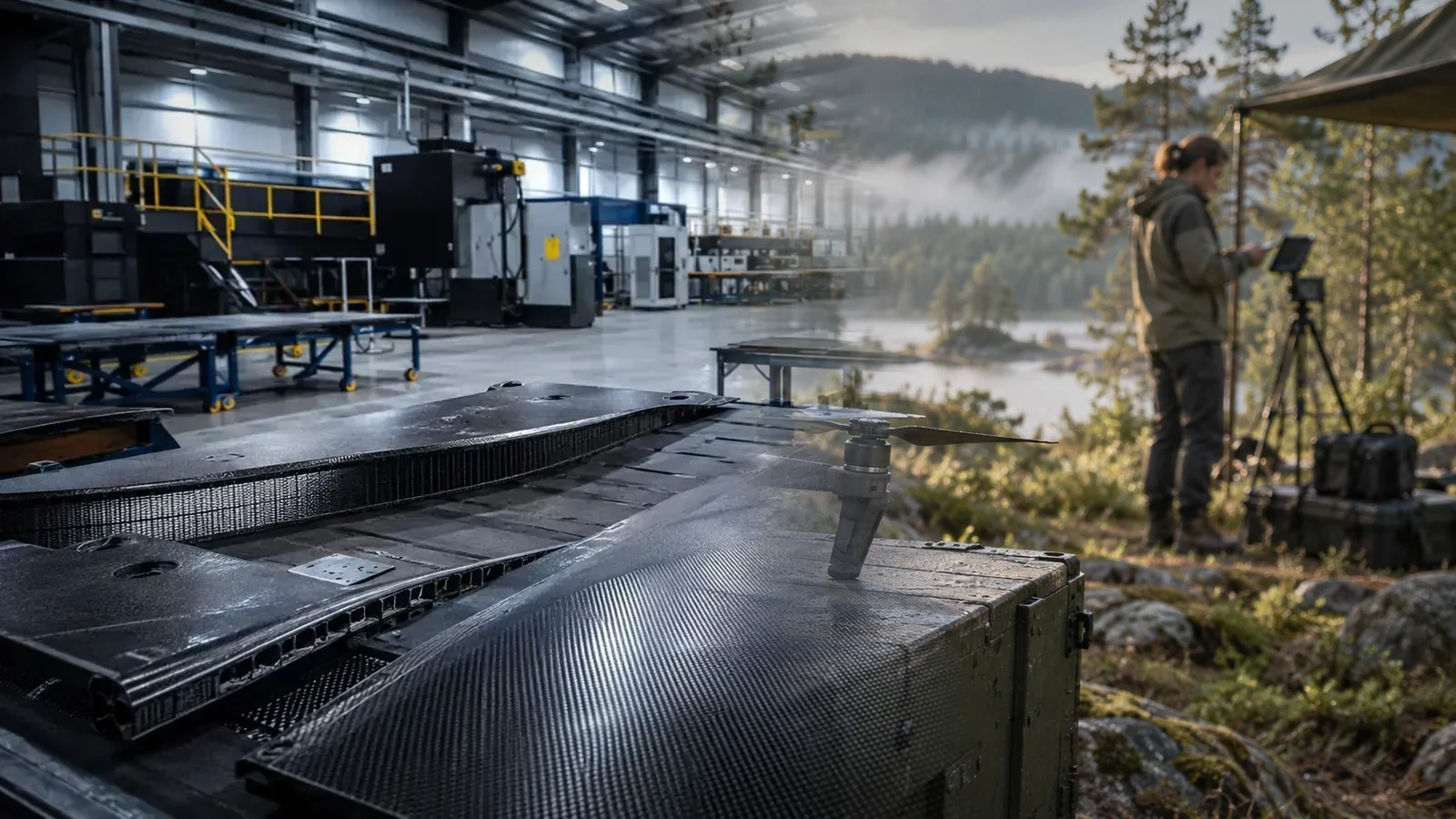
Tiderock Companies and Extremis Systems are moving directly into a full-scale prototype program that combines Tiderock Composites’ existing marine tooling with Extremis’ NEOZANT™ lightweight survivability materials. The initial work is expected to produce a complete hull and deck structure for evaluation rather than stopping at a small coupon or laboratory-scale demonstration.
The companies plan to compare the prototype with conventionally manufactured equivalents across four practical measures: weight, manufacturing cycle time, structural performance and cost. Tiderock Composites will contribute marine engineering experience, established tooling and access to a marine customer for evaluation.
That makes the first phase useful on two levels. It gives the partners a real manufacturing test of how the materials behave at full scale, and it creates operating data that can guide the next stage of development for marine and unmanned platforms.
Source: [1]
Tiderock brings an established composite manufacturing base to the program
The collaboration fits Tiderock’s recent refocus on advanced manufacturing. Tiderock Composites has more than two decades of experience across aerospace, rail, automotive, marine and industrial programs, with capabilities that run from design and tooling through resin-transfer molding, vacuum infusion, CNC processing, robotic trimming, assembly and finishing.
Its marine operation already manufactures lightweight composite hulls and related structures, while its aerospace history includes more than 120,000 composite seating units installed in aircraft worldwide. That production background gives the program an existing pathway from engineered concept to repeatable manufacturing.
Tiderock has also said it intends to extend its UK manufacturing capabilities into the United States through strategic relationships. The Extremis collaboration is the first relationship announced under that refocused strategy, giving the company a concrete program tied to defense, autonomy and high-performance composite structures.
NEOZANT is designed to combine structural strength and protection
Extremis is bringing its proprietary NEOZANT™ materials platform, which integrates a proprietary polymer with carbon fiber and, in selected configurations, advanced ceramics. The company’s published technology materials describe an approach that distributes ballistic energy laterally through the structure rather than relying only on conventional inward deformation.
The broader objective for the Tiderock program is to make survivability part of the platform’s structural architecture. Instead of adding a separate heavy armor package to a finished vehicle or vessel, the partners are evaluating whether the protective material can perform as part of the structure itself.
That approach is particularly relevant for unmanned systems, where every reduction in protective weight can preserve capacity for batteries, sensors, communications equipment, payloads and range. Extremis already manufactures and deploys lightweight protective products for law-enforcement customers, giving the new program an existing materials platform to adapt rather than starting from an unproven concept.
Source: [3]
Unmanned systems widen the potential application beyond the first marine build
The marine prototype is the immediate program, but both companies are positioning the work as a starting point for unmanned maritime and ground systems. Those platforms increasingly carry mission-critical electronics, propulsion systems, communications equipment and sensors, making structural survivability a design issue rather than simply an add-on feature.
The U.S. Army has also been pushing weight reduction in protective systems. In 2025 it awarded $65.5 million for 72,179 Lightweight Small Arms Protective Inserts designed to be about 30% lighter than the then-current ESAPI Generation III plates while maintaining ballistic protection. That procurement provides a useful external signal that weight-efficient protection remains an active defense priority.
For Tiderock and Extremis, the next milestone is straightforward: manufacture the full-scale structure, measure how it performs and use those results to define follow-on work. If the prototype validates the targeted combination of lower weight, structural performance and manufacturability, the same architecture could be adapted across a wider range of autonomous and defense platforms.
Sources and further reading
This independent report summarizes public company disclosures and official source materials. Cornerstone Marketing Inc. received no compensation for this article. It is informational and is not investment advice or a recommendation to buy or sell securities.