
This article was selected without issuer payment or pre-publication approval and prepared under Cornerstone Market Intelligence editorial standards. The source material used is linked on this page.
- Visionary received Newfoundland approval for Phase 2 drilling aimed at resource conversion, expansion and definition of the copper-rich Kraken feeder zone.
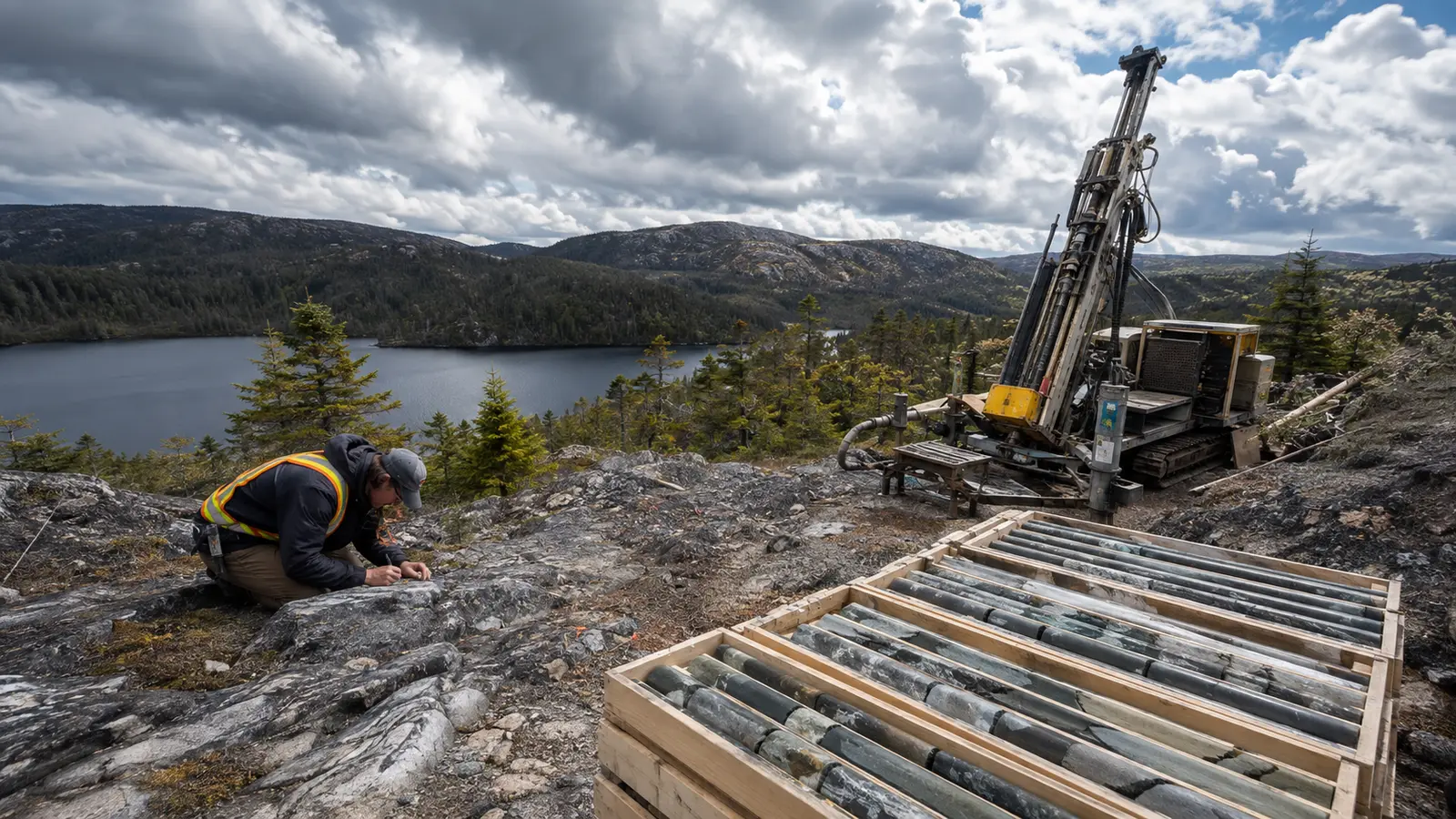
- Visionary Copper and Gold Mines received provincial approval for its 2026 Phase 2 drilling program at the wholly owned Pt. Leamington gold-copper-zinc-silver VMS deposit in Newfoundland.
- The planned program is designed to convert inferred resources to the indicated category, expand the current resource and define the copper-rich Kraken Zone discovered during Phase 1 drilling. Kraken is not included in the project’s 2021 mineral-resource estimate.
The development
Visionary Copper and Gold Mines received provincial approval for its 2026 Phase 2 drilling program at the wholly owned Pt. Leamington gold-copper-zinc-silver VMS deposit in Newfoundland.
The planned program is designed to convert inferred resources to the indicated category, expand the current resource and define the copper-rich Kraken Zone discovered during Phase 1 drilling. Kraken is not included in the project’s 2021 mineral-resource estimate.
Pt. Leamington currently hosts 5.0 million tonnes of indicated resources and 15.4 million tonnes of inferred resources, according to the company. Visionary views additional definition work as a step toward future economic studies, including a preliminary economic assessment.
The project was also selected for Newfoundland’s Junior Exploration Assistance program, which can provide a rebate on eligible exploration expenditures. That support may reduce part of the program cost, but it does not remove the need to fund and execute the drilling.
Receiving approval clears a necessary regulatory step; it is not a drilling result. The next evidence will come from mobilization, completed metreage, assays and an updated model showing whether Kraken adds scale or improves the grade distribution around the existing resource.
Why this matters
The approval allows Visionary to move from planning into the next drill phase at a deposit that already has a defined resource base.
Kraken creates a new resource-expansion angle because the copper-rich feeder interpretation sits outside the 2021 estimate.
Industry and company context
Pt. Leamington is a polymetallic volcanogenic massive-sulphide deposit in central Newfoundland.
The current resource includes both indicated and inferred categories, with different levels of geological confidence.
How to evaluate the update
Resource-conversion holes should be judged by their ability to improve confidence and continuity, not only by isolated grades.
Kraken requires enough drilling to establish geometry, thickness and a defensible relationship to the broader VMS system.
Execution and risk considerations
Permitting approval does not guarantee that drilling will begin on schedule or produce positive assays.
The Kraken feeder interpretation may change as more geological and geochemical data become available.
What to watch next
- Drill mobilization and final Phase 2 metreage.
- Assays from the Kraken Zone and conversion targets.
- Timing of a resource update or preliminary economic assessment.
Cornerstone perspective
Visionary now has the approval needed to test whether Pt. Leamington can grow beyond its 2021 resource framework.
The most valuable outcome would combine successful resource conversion with a well-defined Kraken zone that adds a new component to the deposit model.
This article is informational and is not investment advice or a recommendation to buy or sell securities. Forward-looking statements involve risks and uncertainty. Readers should review the original source and report factual concerns through our corrections page.