This article was selected without issuer payment or pre-publication approval and prepared under Cornerstone Market Intelligence editorial standards. The source material used is linked on this page.
- Group Eleven reported 14.7 metres grading 2.0% zinc plus lead, including 2.8 metres at 8.3%, from a 550-metre step-out at the Stonepark project in Ireland.
- Group Eleven Resources reported a new mineralized interval from hole 26-2638-07 at its Stonepark zinc-lead project in County Limerick, Ireland.
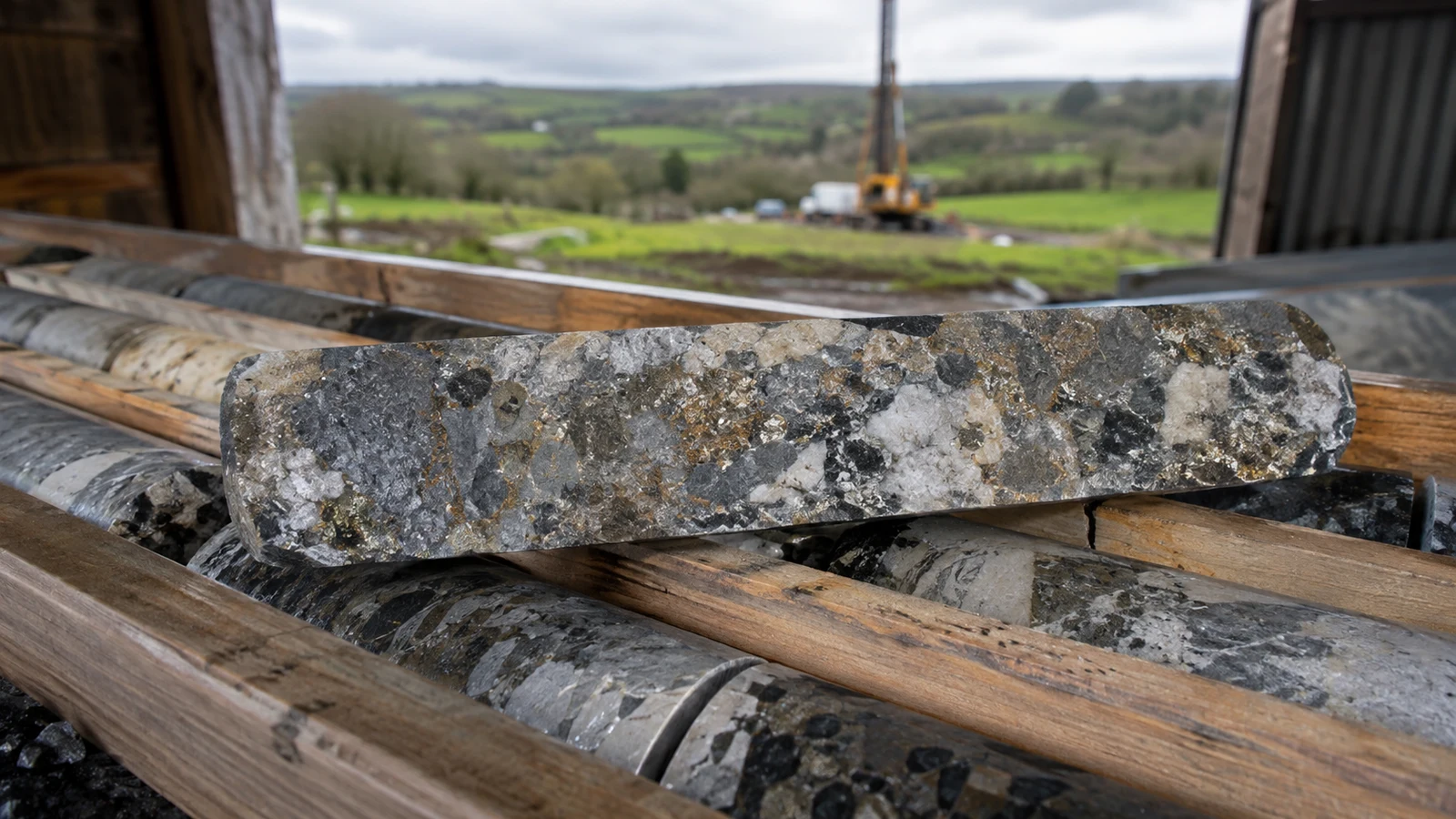
- The company reported 14.7 metres grading 2.0% zinc plus lead from 461 metres downhole, including 6.3 metres at 4.1% zinc plus lead and 2.8 metres at 8.3%. Within the higher-grade interval, one metre returned 21.7% zinc plus lead and 4 grams per tonne silver.
The development
Group Eleven Resources reported a new mineralized interval from hole 26-2638-07 at its Stonepark zinc-lead project in County Limerick, Ireland.
The company reported 14.7 metres grading 2.0% zinc plus lead from 461 metres downhole, including 6.3 metres at 4.1% zinc plus lead and 2.8 metres at 8.3%. Within the higher-grade interval, one metre returned 21.7% zinc plus lead and 4 grams per tonne silver.
Group Eleven said the hole was positioned approximately 550 metres from the edge of the project’s mineral resource estimate and about 150 metres northwest of the nearest historic hole. It estimated true thickness at 90% to 100% of the reported interval.
Hole 26-2638-07 reached 894 metres. Assays from deeper copper-silver targets were pending at the time of the release, and the company planned two additional holes within the remaining approximately 2,700 metres of the campaign.
Why this matters
Mineralization in a large step-out can influence the geological model by testing whether prospective horizons continue beyond the existing resource area.
One hole does not establish a resource extension. Continuity, geometry and grade distribution require additional drilling before the result can support a revised mineral resource estimate.
Industry and company context
Stonepark is a carbonate-hosted zinc-lead project in Ireland’s Limerick region. Group Eleven said its project interest was expected to reach 78.62% following completion of the applicable 2026 fieldwork requirements.
The reported interval contains narrower higher-grade sections within a broader mineralized zone. Investors should evaluate the complete intercept, not only the one-metre peak grade.
How to evaluate the update
Key technical questions include the orientation of mineralization, repeatability in neighbouring holes, recovery and quality-control results, and how the intercept relates to the current resource domains.
The estimated 90% to 100% true thickness is a company interpretation that can change as more structural and stratigraphic information becomes available.
Execution and risk considerations
Exploration drilling is inherently uncertain, and nearby holes can return lower grades, narrower intervals or no comparable mineralization.
Even a future resource increase would not establish economic extraction; metallurgy, permitting, infrastructure, commodity prices and financing remain separate considerations.
What to watch next
- Results from the two planned follow-up holes.
- Pending deeper copper-silver assays from 26-2638-07.
- Any revised geological interpretation around the 550-metre step-out.
- Future updates to Stonepark’s mineral resource estimate and ownership interest.
Cornerstone perspective
The Stonepark result is notable for its distance from the resource edge and the presence of a higher-grade core within a broader interval.
Its importance will be decided by follow-up drilling. Repeatable mineralization and a coherent model matter more than the headline grade from one metre.
This article is informational and is not investment advice or a recommendation to buy or sell securities. Forward-looking statements involve risks and uncertainty. Readers should review the original source and report factual concerns through our corrections page.