
A detailed review of the business, leadership and publicly reported progress. Sources checked September 5, 2026.
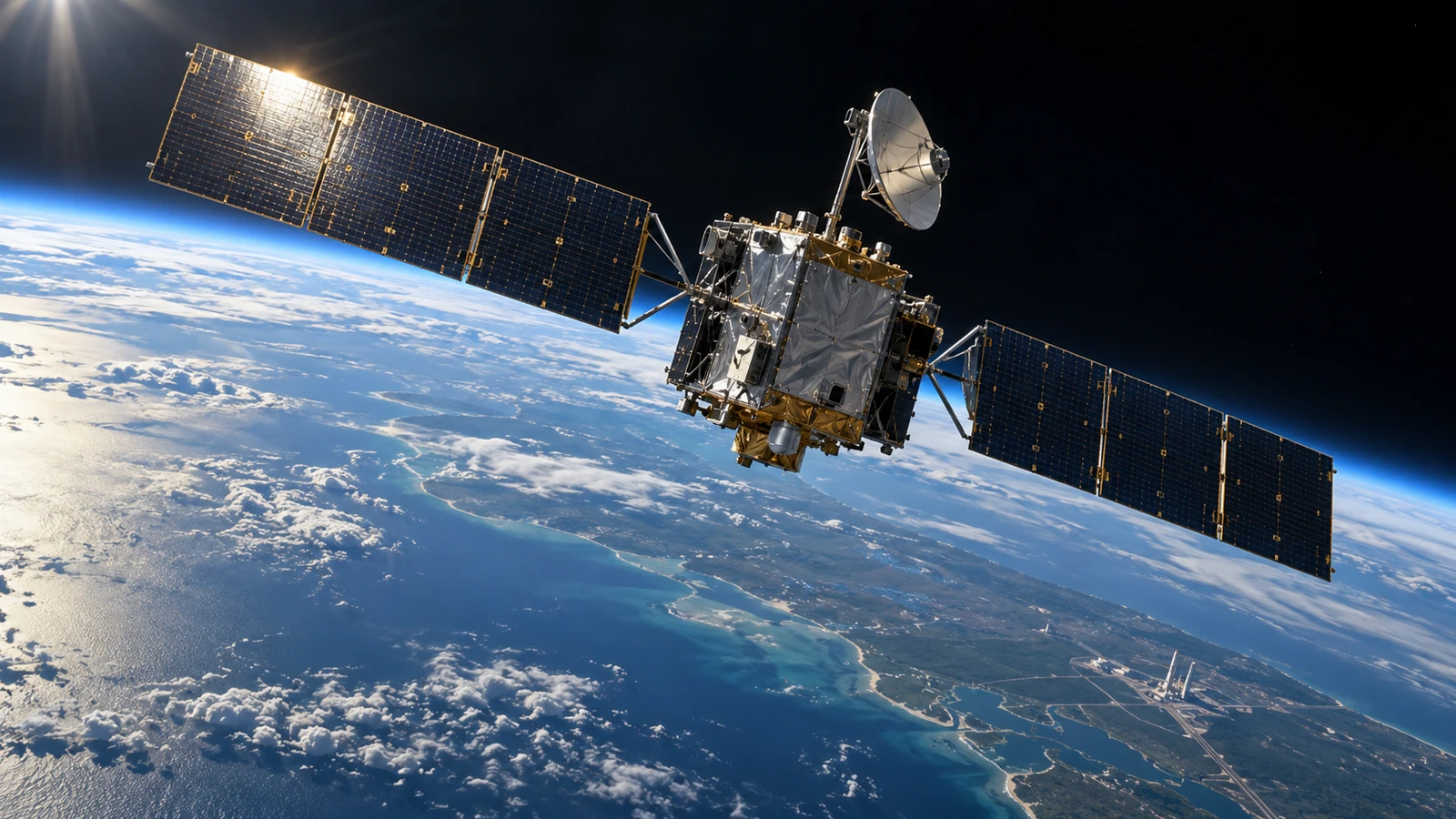
Conceptual editorial illustration; not a photograph of company assets or personnel.
- Launch and spacecraft manufacturing give Rocket Lab several ways to serve a mission.
- Second-quarter revenue reached US$234 million; backlog was US$2.36 billion.
- Neutron and the proposed Iridium acquisition represent distinct future growth programs.
A space business with several ways to grow
Rocket Lab’s appeal as a company becomes clearer when its activities are viewed as parts of a complete mission. A customer needs a spacecraft, components that keep it working, a launch into the appropriate orbit, and the ability to operate after deployment. Rocket Lab has built capabilities across that sequence. Its commercial opportunity therefore extends beyond the moment a rocket leaves the pad.
This feature examines the company through three questions: what customers can buy today, what recent execution shows, and how management is broadening the business. The resulting picture is of a manufacturer and mission provider building greater depth around an established launch operation. The strategic connection between those activities is Cornerstone’s interpretation of the company’s disclosed capabilities.
Electron: control over the mission matters
Electron provides dedicated launch services for small satellites. Rocket Lab emphasizes tailored orbits, scheduling control and responsive access to space. Its Kick Stage supports precise deployment and multiple orbital adjustments, giving mission planners options beyond simply reaching orbit.
That flexibility is commercially useful. A satellite’s value depends partly on arriving where it can perform its intended job and on a schedule that fits the customer’s broader program. For a company assembling a constellation, a dedicated flight can also serve a particular replacement or expansion requirement. Electron gives Rocket Lab a direct relationship with those mission planners, creating an entry point for additional spacecraft and component work.
The business lesson is straightforward: specialized launch capability can be valuable because of the customer problem it solves. Payload size alone does not describe the service.
Sources: [2]
Space systems add depth beyond launch
Rocket Lab offers spacecraft design, assembly, integration, testing and operation for commercial, civil, defense and intelligence missions. Its internally produced components include propulsion, reaction wheels, star trackers, solar products, radios and software. Those products address different parts of a spacecraft’s needs, from power and communications to orientation and maneuvering.
This creates two routes to customers. Rocket Lab can provide a complete spacecraft, or supply equipment used within somebody else’s mission. In Cornerstone’s assessment, that is an important feature of the model: participation in space activity need not depend on winning the entire mission contract. Component supply can build relationships that later support larger programs.
The opportunity is strongest when this breadth translates into coordinated engineering and dependable delivery. A supplier able to understand several interacting spacecraft systems can become useful earlier in a customer’s design process.
Sources: [3]
What the latest operating results show
For the quarter ended June 30, 2026, Rocket Lab reported US$234 million in revenue, up 62% year over year, and US$2.36 billion in backlog. Both were company records. Its August 10 update also identified the completed acquisitions of Mynaric and Motiv, broadening the capabilities available within the group.
Revenue and backlog answer different questions. Revenue shows work recognized during the reporting period. Backlog describes contracted work awaiting future delivery and recognition. Together, they provide evidence of both present activity and a pipeline of customer commitments; backlog should not be treated as cash already earned.
For this company profile, the encouraging point is the combination of growing recognized business and additional operating capabilities. It provides a more substantial foundation for discussing expansion than a launch announcement in isolation.
Sources: [1]
The people connecting engineering and execution
Founder Sir Peter Beck serves as president and chief executive officer and chairs the board. Chief Financial Officer Adam Spice leads the finance function, while Chief Operations Officer Frank Klein is responsible for scaling manufacturing. The executive team also includes Shaun D’Mello, vice president for Neutron, and Dr. Brad Clevenger, vice president for Space Systems.
These roles map closely to the company’s priorities: technical direction, capital allocation, production capacity and the development of major product lines. Beck’s continuity provides a connection to the company’s engineering origins, while dedicated operations and business-unit leadership creates accountability as the organization grows.
Cornerstone’s view is that the structure matters as much as any single biography. A broad space company needs the ability to coordinate specialist teams, make investment choices and deliver customer programs simultaneously. The published leadership roster shows responsibilities distributed across those requirements.
Sources: [4]
Neutron and Iridium address different opportunities
Neutron is Rocket Lab’s reusable medium-lift launch program. Its strategic role is to address missions beyond Electron’s small-satellite focus. Development, qualification and dependable commercial service are successive milestones; the program’s opportunity should be understood through that progression.
The proposed Iridium acquisition would add another dimension: operating satellite communications services. Under the announced agreement, completion is expected in mid-2027 and remains subject to shareholder and regulatory approvals and other closing conditions. It is a proposed transaction, so Iridium’s operations are not presented here as an already consolidated Rocket Lab business.
The two initiatives are complementary in concept. Neutron expands the missions Rocket Lab aims to launch, while Iridium would extend its participation into ongoing services delivered from space. They also give readers two separate sets of progress markers to follow, rather than one undifferentiated expansion story.
The next chapter: turning breadth into repeat business
The most constructive way to follow Rocket Lab is through the connection between its businesses. Watch how launch customers use its spacecraft capabilities, how component programs progress into deliveries, and how manufacturing supports a larger number of concurrent missions. For the future programs, technical updates and transaction milestones provide separate checkpoints.
Cornerstone’s assessment is that the company’s strongest strategic characteristic is its range of customer relationships across the mission lifecycle. A useful next question is how often those relationships produce additional work and whether each new capability makes the existing operation more valuable to customers.
That gives the profile a clear organizing principle: assess the business as a growing set of mission capabilities, supported by reported execution and identifiable leadership. Share-price performance is a separate question from the operational progress described in this feature.
Primary sources
This article is informational and is not investment advice or a recommendation to buy or sell securities. Forward-looking statements involve risks and uncertainty. Readers should review the original source and report factual concerns through our corrections page.